

Glenna Batson
While scientists continue to investigate modes of pain management, self-help methods that highlight sensory awareness and rest are gaining currency.
In the last blog, I suggested an easy sensory awareness tool: a quick, reflective moment of checking in with yourself to see how things are going. This simple practice only takes a blink of an eye to determine whether you are becoming more stressed – thus, I coined the term body blink. Body blink is a potent way to pause – take a breath – and step back from unnecessary mental and physical effort.
In this blog, however, I will invite you to indulge in a lengthier rest period: 20-minutes of constructive rest. Rest is an integral part of our circadian rhythm, allowing mind and body to go ‘offline’ from the accumulated stress of a work day (Batson 2009). Yet, rest can be intentionally constructive – suggesting mindful mental work is going on without stressing the body.
Carving out this time for yourself each day is a critical act of self-care. Although the final word is not out for pain management, it appears that twenty to thirty minutes of constructive (meditative) rest is recommended to calm the nervous system and restore homeostasis.1 This time protocol was established by mindfulness expert Dr. Jon Kabat-Zinn – one that helps shift from being stressed towards a more restful, embodied state of wellness (Kabat-Zinn 2017).
Rest and Somatic Practices
Augmented rest is a basic hallmark of somatic education (Batson & Schwartz 2007). A resting phase of varied duration commonly is interspersed between various points of active movement. Benefits include restoring physical and mental homeostasis, memory consolidation of movement or motor learning, and – perhaps best – helping hone awareness to our needs (Batson & Wilson 2014; Batson 2009). These needs often lie deep within the soma (body-mind working together), surfacing only when given the time and space to allow the body to speak.
These mind-body approaches find evidence in science for multiple chronic pain conditions (Skelly et al, 2018), with solid research studies supporting somatic approaches for alleviating chronic back pain using Alexander Technique (Little et al, 2014), and Feldenkrais Method (Paolucci et al, 2017).
As I mentioned in the first of this blog series, a body blink is a form of rest that is possible in any position. It’s a great tool when ‘on the go.’ But when a longer interval of time is needed, lying down is best. This offers a way to surrender weight into gravity, and suspend all the daily ‘doing’ tasks.
While multiple options exist for resting while lying down, there’s value in constructive rest position (CRP) for pain transformation, where it is possible. CRP is the commonly known ‘semi-supine’ position (or hook-lying) – on your back, knees bent, arms relaxed by the side. Ideokinesis pioneer Dr. Lulu Sweigard (Sweigard 1974)2 , used the CRP distinctly distinctly to put all body joints in as near an anatomical neutral as possible (Ibid, p.216).
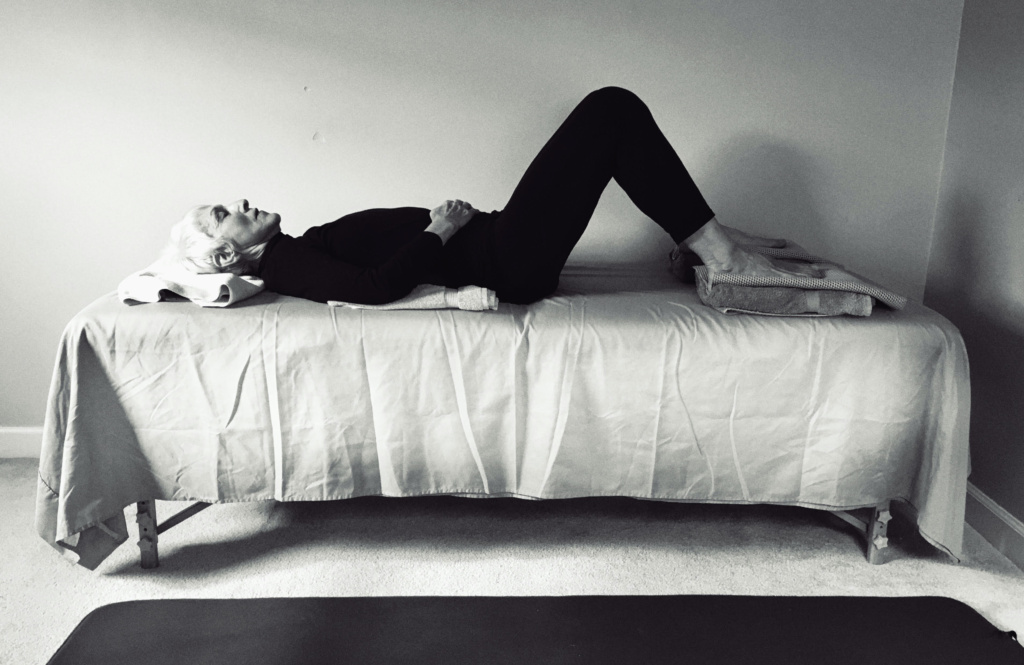
Restoring anatomical neutral means positioning the body (spine and head, ribs, pelvis), and all peripheral joints, such that the muscles exert the least activation possible (passive pull or stretch). This helps restore joint space and rest muscle length – a wonderful way to facilitate the redistribution of fluids to offset the work done in gravity.
This is a radical form of resting because it allows the body to self-regulate without otherwise trying to fix a problem, that is, it is not imposing on your body’s wisdom by over-directing. Even if the mental mantra is to ‘relax,’ the body cannot translate this command if it has not experienced a deep sense of ease and letting go. Instead of being led by good intentions to fix oneself, given enough rest and physical support, the sensations of relaxation can arise without interference.
Practice
Let’s give it a try. You could read below and then try it out, or ask someone else to read it to you as you are resting.
Find a quiet spot to lie down on your back if you can. Place a small towel under your head, and one under your arms, so you remove the weight of the extremities. If other body parts need support (such as the tail bone), you can continue to bolster them with folded hand towels or blankets. I call this ‘pontooning’ – removing the friction of body-to-surface and helping restore joint neutrality, so the body parts can ‘float.’
If you encounter pain during the process, see if there’s another way for a small pillow or towel to support you. And if supine lying is problematic, you can try ¾ lying or side-lying with a bed pillow in front of your torso to support an arm or between your thighs, for example.
Once settled, close your eyes. Use a small eye covering to block out bright light. Remain doing nothing for at least 2 minutes – and I mean, do nothing. Just give body and mind time to settle down. You might be surprised how long it can take for the noisy mind to start quieting down.
Begin then to follow your breathing – not as air volume, but as movement – allowing the breath to ‘do itself’. Note how your breath channels through multiple pathways, pauses, swirls and changes direction. Trust that your breath is doing what you need. You do not need to enhance it through deliberate intention such as taking larger breaths, or directing it to any place.
Focus on sensing the midline of your body, the deepest recesses of your middle – perhaps that place behind your heart is a good place to start. Imagine slightly drawing in all of your body parts towards midline, each joint gently coupling with another. You are inviting your body to become more integrated and receive more wholistic support.
You may need to set a timer, but you can also just decide to follow the resting interval you feel you need. Note, though, that you might be short-changing yourself with less than 20 minutes. So, if it’s simply not possible to indulge your daily sensory bath today, then 10 minutes will suffice and tomorrow awaits you.
Notes
- Homeostasis is a unifying principle of biology where in the various control systems of the body restore and maintain a constant internal environment in response to environmental changes. Various feedback mechanisms to these different systems help bring sympathetic and parasympathetic impulses of the nervous system into balance.
- Ideokinesis is a form of mental practice with a long legacy that dates back to the early 20th century. The concept that using the imagination alone would prime the motor nerves needed for efficient action was first used widely by sports psychologists. Called ‘mental practice’ or ‘mental rehearsal,’ athletes could use their mind’s eye to train the mind-body connection through covert (imagined) sports practice. Through the work of physical educators Mabel Todd, Barbara Clark and Lulu Sweigard, the concept was adapted for use within dance circles and the lay public. Dr. Lulu Sweigard popularized the word Ideokinesisi from the word roots ideo (idea) and kinesis (movement) (Sweigard 1974). Ideokinesis was one of the earliest of the somatic practices widely employed within dance training. To practice ideokinesis, dancers would assume the constructive rest position, and use only their imagination alone to visualize an action (thereby inhibiting muscle activation). In Dr. Sweigard’s classic protocol, students would learn to visualize her nine ‘lines of movement’ without muscular engagement. The uniqueness of these ideokinetic nine lines (as opposed to mental rehearsal) was to improve muscular balance and skeletal alignment that would lead to better coordination. Sweigard’s work continues to inform dance training to this day. For further information about the legacy and for references see: http://www.ideokinesis.com and https://thinkingbody.org
References cited
Batson G. The Somatic practice of intentional rest in dance education – Preliminary steps towards a method of study. Journal of Dance and Somatic Practices, 2010;1(2):177-197.
Batson G, Schwartz RE. Revisiting the Value of Somatic Education in Dance Training Through an Inquiry into Practice Schedules. Journal of Dance Education. 2007;7(2):47-56.
Batson G, Wilson MA. Rest and Recovery: Making it Doable for Dancers, In: Wilmerding, V. and Krasnow, D., (Eds.), Dancer Wellness, Champaign, IL: Human Kinetics Press, 2014.
Harvard Health Publishing. Harvard Medical School. Six ways to use your mind to control pain. April 2015, https://www.health.harvard.edu/mind-and-mood/6-ways-to-use-your-mind-to-control-pain
Paolucci T, Zangrando F, Iosa M, et al. Improved interoceptive awareness in chronic back pain: a comparison of Back school versus Feldenkrais method. Disability in Rehabilitation 2017, 39(10) 994-1001.
Little P, Stuart B, Stokes M, et al. Alexander technique and supervised physiotherapy exercises in back pain (ASPEN): a four-group randomised feasibility trial. NIHR Journals Library, 2014.
Skelly AC, Chou R, Dettori JR, et al. Noninvasive nonpharmacological treatment for chronic pain: a systematic review. AHRQ Comparative Effectiveness Reviews. Rockville (MD): Agency for Healthcare Research and Quality (US); 2018 Jun. Report No.: 18-EHC013-EF. https://effectivehealthcare.ahrq.gov/products/nonpharma-treatment-pain/research-2018
Mindfulness Staff. Jon Kabat-Zinn: Defining Mindfulness. What is mindfulness? The founder of Mindfulness-Based Stress Reduction Explains.Blogpost 11 January 2017, Accessed 27 July 2020. https://www.mindful.org/jon-kabat-zinn-defining-mindfulness/
Glenna Batson, ScD, PT, MA
For nearly 5 decades, Glenna has worked at the intersection of dance, somatic education, human movement science, and rehabilitation medicine. She currently is an independent scholar, teacher, and advocate for in the somatically-based dance with higher education and healthcare both in the USA and in Ireland. Her pioneering work in improvisational dance for people living with Parkinson’s disease has been disseminated within multiple communities, conferences, and publications.
This blog does not provide medical advice and the views and opinions expressed in each blog post belong to and are the responsibility of the author(s) of the blog posts. Any information that you use is at your own risk. You should always consult with a health care professional about any general or specific health concerns.
